Seattle Urban Forest Commission open meetings act violations and continued delays in filling vacant Urban Forestry Commission positions

Dear OSE Acting Director Lylianna Allala,

Congratulations on your appointment to head up the Office of Sustainability and Environment.

I wanted to bring to your attention several ongoing issues that have been raised by myself and other members of the public at meetings of the Seattle Urban Forestry Commission starting in 2025 and continuing in 2026.  I and other members of the public have raised these issues numerous times in public comments before the Commission, but these issues continue to be unaddressed by Commission staff.

The first issue concerns violations of the Washington State Open Meetings Act and not complying with the stated  responsibilities in the Commission’s bylaws to post meeting materials and recordings, not keeping the commission’s website updated, not posting draft meeting notes and other documents the Commission will vote on in advance of the meeting on the agenda, and not timely posting adopted meeting notes.

The second issue concerns continued lengthy delays in filling vacant Urban Forestry Commission seats, which reduces expertise needed to help evaluate issues before the Commission.

Steve Zemke – former Urban Forestry Commissioner for 6.5 years

Chair of Tree PAC and Friends of Seattle’s Urban Forest

The first issue regards violations of the Washington State Open Meetings Act: 

Inadequate Posting of Urban Forestry Commission meeting agendas, digital recordings and adopted minutes  (for Years 2025 and 2026)

  • No digital recording of meetings posted – Feb 2025, March 2025, July 2025, Nov 2025, Jan 2026, Feb 2026
  • No draft meeting notes  posted – March 2025, Oct 2025, Nov 2025, Jan 2026, Feb 2026
  • No  adopted meeting notes posted – Feb 2025, March 2025, Oct 2025, Nov 2025, Jan 2026
  • No agenda posted – Nov. 2025 (link does not work)

The Jan 13, 2021 adopted Coordinator Protocols for the Seattle Urban Forestry Commission state the following responsibilities:

  • 6. Record Commission meetings and produce meeting summaries for review and adoption by the Commission
  • 8. Manage and update Commission’s website, including posting meeting materials and recordings.
  • 10. Coordinate internal and external Commission communications. 

For comparison, postings in 2021 to 2024, are complete and detailed and meet requirements of the Washington State Open Meetings Act. They also meet the adopted Coordinator protocols. In addition, separate posting of presentations by city staff make it much easier to find and share highlights of meetings, presentations, adopted UFC positions and letters and not having to search through an entire 2 hour recording to find a presentation.

The second issue is continued lengthy delays in filling UFC vacancies:

The second issue is the continuation of delayed appointments to fill Urban Forestry Commission vacancies which reduces key urban forestry areas of expertise on the Commission. Current vacant positions include:

  • Position 4 – hydrologist – vacant since Oct 2025 (mayoral appointment)
  • Position 6 – landscape architect – vacant since August 2025 (mayoral appointment)
  • Position 7 – NGO Representative – vacant since April 2025 city council appointment)
  • Position 8 – development or utility representative – vacant since Jan 2026 (mayoral appointment)
  • Position 9 – economist, financial analyst, realtor or similar professional – vacant since Sept 2025 (Urban Forestry Commission appointment)

The Jan 13, 2021 adopted Coordinator Protocols for the Seattle Urban Forestry Commission states the following responsibility:

  • 13. Run recruitment processes for Commission members in Coordination with City Council and Mayor’s Office staff. 

As in 2025, vacancies are still not being timely filled.

There is no notice on the UFC website regarding a timeline or process to fill these vacancies.  These vacancies are taking months to fill. Delays reduce the actual time the Commissioners serve. Once a seat is either known to be vacant due to a resignation or an end of a term with notice someone does not want to be reappointed to a second term, or a second term is known to be ending, the information on how to apply, including where to send a resume and letter of interest should is available on the UFC website so that vacancies can be filled much quicker.

While there are currently 5 vacant positions, the Seattle Boards and Commissions website currently only lists 3 vacancies on their website. They also need to be timely notified.

Please note. The above comments on posting meeting agendas, recordings, minutes,  posting separate presentations and timely efforts to fill vacant UFC positions are meant to be helpful. The goal should be to increase public accessibility and the functioning of the Seattle Urban Forestry Commission. Resolving the stated issues will help UFC commissioners, the Office of Sustainability and Environment, city staff, the City Council and the Mayor’s office as well as the public and news media in being updated on the commission’s meetings, presentations, recommendations and other activities.  This is especially helpful for anyone who is not able to attend a meeting but wants to review what was presented and discussed. A good updated public record also greatly assists new Commissioners in getting up to speed much quicker on urban forestry issues before the Commission that they are expected to help advise the City Council and Mayor on.

This e-mail was sent to Seattle’s Office of Sustainability and Environment, OSE’s acting Director, OSE’s Urban Forestry Coordinator, UFC’s Liasson and the Seattle City Council’s Chair of the Land Use and Environmental Sustainability Committee. on Feb. 19, 2026. It is now March 3, 2026 and no response has been received and no correction have been made on the Seattle Urban Forestry Commission website.
 

Explaining why key provisions are in the 2019 Seattle Urban Forestry Commission draft Tree and Urban Forest Protection Ordinance

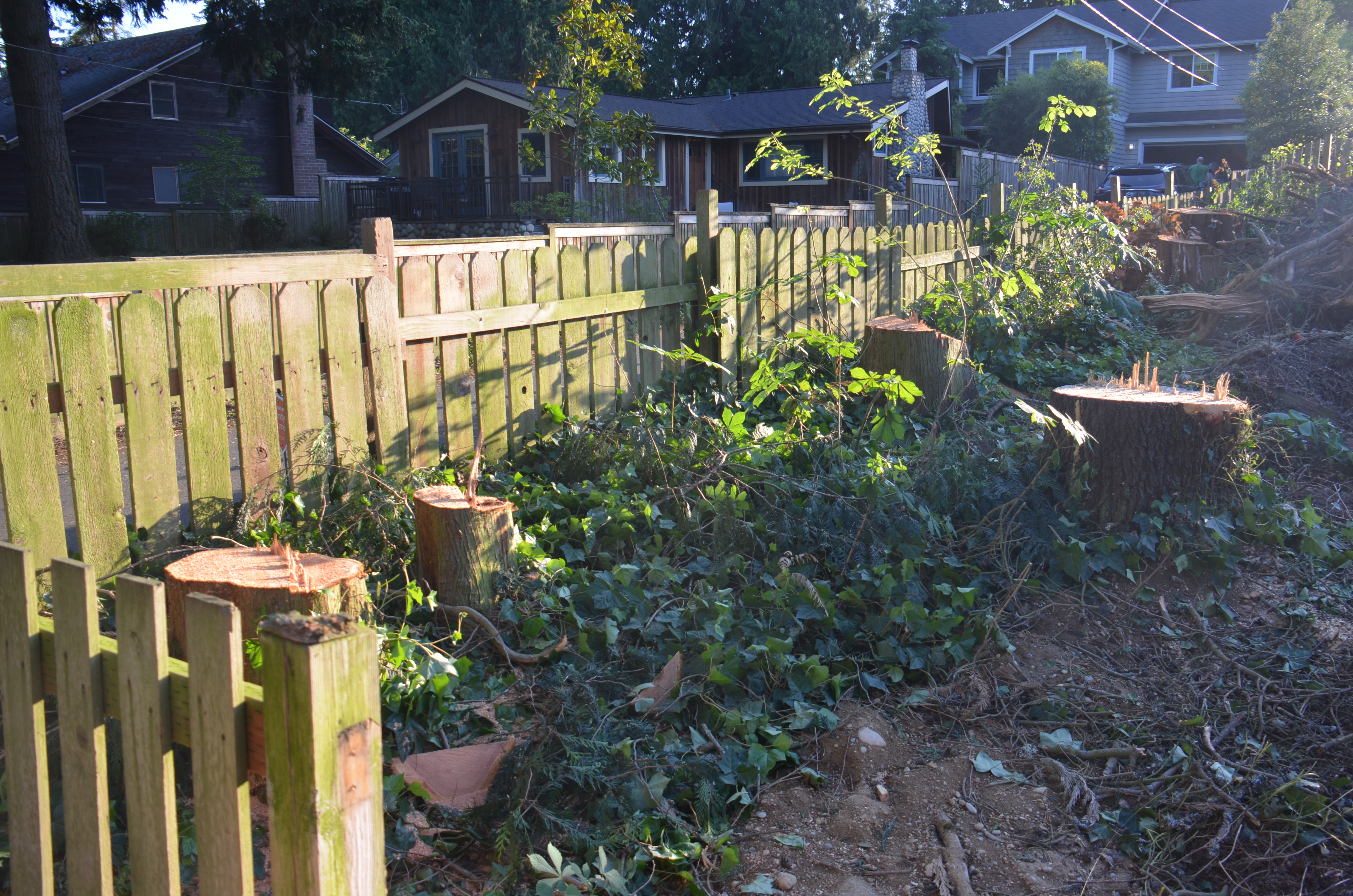
North Seattle Clearcut – Victory Hts

North Seattle Clearcut – Victory Hts


In June 2019, The Seattle Urban Forestry Commission submitted, at the request of Seattle City Councilmember Sally Bagshaw and Lisa Herbold,  a draft Tree and Urban Forest Protection Ordinance to the Seattle City Council and Mayor Jenny Durkan.

The Coalition for a Stronger Tree Ordinance is urging the public and  organizations to submit letters of support on the draft ordinance through the website www.DontClearcutSeattle.org.  A pre-written draft letter for individuals is available on the site to which additional comments can be added. A draft resolution is available for organizations to use to express their support.

Here is some further explanation on each item mentioned in the support letter for the Urban Forestry Commission’s draft Tree and Urban Forest Protection Ordinance.

1. Expand the existing tree removal and replacement permit program, including 2-week public notice and posting, as used by the Seattle Department of Transportation (SDOT) – to cover all trees 6” DBH and larger on private property in all land use zones, both during development and outside development.

 Explanation – Seattle currently has a complaint based system to monitor tree removal. It doesn’t work because people only know a tree is being cut down when they hear the chain saw. Many trees are removed illegally. Exceptional trees on private property as defined by Director’s Rule 16-2008 are not to be removed unless hazardous. The first sign a tree is being removed is usually hearing a chain saw  or seeing the tree gone when they pass by. Many other cities like Portland,OR; Atlanta, GA; Vancouver,BC and locally Sammamish, Shoreline, Mercer Island, Redmond, Lake Forest Park and and Bellevue all require permits before trees can be removed, 

 According to the  Seattle Forest Ecosystem Values Report , 6″ DBH (diameter at 54″ high) and larger trees represent about 45% of the trees in the single family zone. That means 55% are smaller than 6″ DBH. A Douglas fir at 6″ DBH is about 30 years old.

During development and outside development – also means property on which construction is occurring and property on which construction is not occurring.

Notice – posting is to let neighbors know if a tree is legally being removed.

 2. Require the replacement of all trees removed that are 6” DBH and larger with trees that in 25 years will reach an equivalent canopy volume – either on site or pay an in-lieu fee into a City Tree Replacement and Preservation Fund. Allow the Fund to also accept fines, donations, grants and set up easements.

Explanation – Many cities require tree replacement when trees are removed. If trees are not replaced you are losing canopy. 

Seattle’s Tree Protection ordinance passed in 2001 actually says in SMC 25.11.090:

  “Tree replacement and site restoration. A. Each exceptional tree and tree over two (2) feet in diameter that is removed in association with development in all zones shall be replaced by one or more new trees, the size and species of which shall be determined by the Director; the tree replacement required shall be designed to result, upon maturity, in a canopy cover that is at least equal to the canopy cover prior to tree removal. Preference shall be given to on-site replacement. When on-site replacement cannot be achieved, or is not appropriate as determined by the Director, preference for off-site replacement shall be on public property.” 

The city has not kept a  record of  trees removed or replaced pursuant to this ordinance nor is there any record of developers paying the city to plant trees elsewhere. The city  has not been enforcing this part of the ordinance. 

Note: The current draft lowers this provision to replace trees to 6″ DBH and allows trees to be planted on private property in the city that needs more trees as part of the race and social justice initiative. The requirement to replant trees is extended to private property owners as many other cities do ,including Portland,OR. 

The fee in lieu dollar amount would be set by DCI and is not in the ordinance, so it can be set and raised or lowered to ensure compliance and deal with changing costs over time. There is no replacement fee if replacement trees are re-planted on the property they were removed from. DCI would also have the authority  to reduce, delay or cancel in-lieu-fees, depending on a property owner’s  financial circumstances.

3. Retain current protections for Exceptional Trees and reduce the upper threshold for exceptional trees to 24” DBH, protect tree groves and prohibit trees over 6”DBH being removed on undeveloped lots (vacant lots).

Explanation – There are about 6100 large exceptional trees left in Seattle according to the 2016 Seattle Tree Canopy Assessment. These are trees over 30″ DBH and up to 140 feet tall and probably 100 years old or more.  They are the survivors and provide the most ecological services to the city. They include Douglas fir, western red cedar and Big Leaf Maples. Reducing the diameter to 24″ DBH will protect more of these large trees that have lived longer than most people in the city, and will be impossible to replace in our, or our children’s, lifetime.

See Reasons to Save Big Trees in Urban Areas Friends of Urban Forests

4. Allow removal of no more than 2 significant non-exceptional trees in 3 years per lot outside development (i.e. no construction occurring)

Explanation – Seattle currently allows the removal outside development of 3 significant (> 6″DBH) trees that are not exceptional per year. This can quickly remove all trees on a lot. A number of other cites have lower numbers and limit it even more over a longer time period. Renton limits it to 2 trees in 1 year and 4 trees in 5 years as an example. 

5. Establish one citywide database for tracking tree removal and replacement permits, and to track changes in the tree canopy. Post online, all permit requests and permit approvals for public viewing.

 Explanation -The database system to track tree loss and replacement was recommended in the 2017 Tree Regulations Research Project report.  Mayor Burgess, in his 2017 Tree Protection Executive order, directed it to be set up to track tree loss and replacement.

6. Expand SDOT’s existing tree service provider’s registration and certification to register all tree service providers (e.g. arborists) working on trees in Seattle.

Explanation – SDOT has already set up a a system to register and certify tree service providers and this would extend it to all that work on trees on private property. Providers would have to sign a statement that they have read the tree regulations and understand what is required. 

7. Provide adequate funding in the budget to implement and enforce the updated ordinance.

Explanation – DCI currently is understaffed regarding tree protection functions that include monitoring tree related issues and checking compliance with existing regulations, site inspections etc. This funding will be required to implement and better enforce the existing and updated ordinance.

cross posted on www.Friends.UrbanForests.org