
Article from koin.com: Protesters vs chainsaws over trees in Portland
PORTLAND, Ore. (KOIN) — Giant century-old trees targeted for takedown in Southeast Portland have a number of people ready and willing to do what may be necessary to save them.
A cluster of trees was already taken down near SE 41st Avenue and Clinton Street, with 2 more set for removal. Residents in the area don’t seem opposed to the development surrounding it, but don’t understand why the trees need to be taken out.
Some protesters have said they are willing to chain themselves to the trees to stop their removal.
Read the full article at koin.com
32 acres of land on Myers Way subject of meeting to save it

Copied from http://www.westseattleherald.com/2015/02/27/news/32-acres-land-myers-way-subject-meeting-save-it
A community meeting aimed at preserving 32 acres of land on Myers Way South is set for March 14. Organizers say that they need to reach the threshold of 500 people who choose to keep that land undeveloped, and eventually for it to become “Discovery Park South”, otherwise they say it could be sold for the possible site of a Lowes Hardware Store.
Information from the organizers
The City of Seattle intends to sell the Myers Parcels for commercial development soon, most likely to LOWES. Seattle Parks has indicated it does not want it. If 500 people say they want it to become Discovery Park South, they will reconsider.
WHAT: Myers Parcels occupy 32 acres of undeveloped surplus land owned by the City of Seattle It is steep, wooded slopes, wetlands, and a meadow.
WHERE: The land is located in south and east end of West Seattle, between White Center and Highland Park. It is adjacent and south of the Joint Training Facility, 9401 Myers Way South and Arrowhead senior housing.
CONTACT: Cass Turnbull: cassturnbull@comcast.net or 206-783-9093
HELP: Send an email to the Mayor and/or your councilmember saying you want Myers Parcels saved as Myers Park, a natural area.
COME: You are invited to come to the first ever gathering of SAVE MYERS PARK, on Saturday March 14th, 10-noon, at the offices of the Duwamish River Cleanup Coalition, 210 S. Hudson.
Call or email Cass to confirm and for questions. 206-783-9093. Or email cassturnbull@comcast.net.
The story of the Myers Parcels:
By Cass Turnbull
The Myers parcels may be the last large, undeveloped piece of property that could become a major park in Seattle. It is 32 acres of surplus land already owned by the City. It is located at the south border of West Seattle, between White Center and South Park. It is an easily ignored piece of land, it seems remote from the industry, the homes, and certainly from the building boom that is elsewhere. You can see 509 from it and it is surrounded, and locked up entirely, by a chain link fence. You might not even notice it when driving north to get to the 1st Ave Bridge.
I noticed it because it has woods, fields and as I found out, water. And because of my work on the Save Our Substations project I knew it was City owned surplus land. After researching its history I can say that Myers is a much abused piece of God’s green earth. For most of its modern history it was mined as a gravel pit. Nintendo owned it for a while and insisted that Seattle buy all 50 acres of the property if they wanted to buy any of it. The best piece, the centrally located flatland, became Seattle’s interdepartmental Joint Training Facility.
Then in 2007, just before the great recession, the rest of the land was put up for sale by the Council. The City wanted to pay off an interdepartmental loan on the land and stimulate the economy in underserved south Seattle. For various reasons the deal with LOWES flipped.
Development has recently begun to nibble at the corners. The property just adjacent to the North has become a spiffy new building complex for retired people. Above the steep cliff and to the west the King County Housing, people decided to turn over large swaths of their land to build Greenbridge, which is the latest thing in mixed use housing designed to deal with Seattle’s affordable housing problem. The steep greenbelt to the north of the retirement complex got taken by parks as part of the Westcrest Park, thank God. It extends the Duwamish greenbelt to, you know, Myers. On the east side of Myers Way, located behind an inconspicuous hole in the chain link fence, is a trail going down the steep wooded hill to SR 509. A homeless camp is hidden there that has been beautifully landscaped and cleaned by its members.
As for Myers proper, the Firemen decided they needed to build their own dream training facility (for $33 million of your tax dollars, about the price of the entire pieces of land). A local environmental hero, John Beal, fought to stop the development because Myers feeds Hamm creek, one of the tributaries of the Duwamish. He had spent 22 years of his life restoring the Hamm. Some say that losing the battle against the training facility caused the heart attack that killed him shortly thereafter. Seattle was fined, but the construction continued and was finished. Now you can see the center. You can’t enter the Firefighter’s facility itself, its security gated and fenced, but sometimes you can see pink smoke arising from a concrete tower. From Google Earth you can see roads lined in big red tucks. A tiny duck pond at the visitors parking area is what remains of the wetland.
Money is always the problem. The State Accountancy Act says you can’t just give or transfer property from one department to the other. I’m investigating several possible ‘work-arounds’ to make the land affordable, or perhaps even free. I applied for grants to create a think tank of a lawyer, a strategist, and policy analyzer to check out the feasibility of various possible options. Now we need a coalition of supporters to build momentum to save the property.
The kids of future Seattle will not have what I had as a girl growing up in Seattle. Because of the avalanche of density headed our way, there just won’t be the backyards, the vacant lots and the empty campgrounds of my youth. Exploring the vacant lot next door is how I came to love nature. I want the kids of Greenbridge to be able to bike to Myers Park to climb trees, build forts, play in mud, and pretend they are in some distant wild place. I want a place where there are frogs to hear, crickets to catch, a killdeer and swifts to watch, or perhaps even a salmon spawning.
The Great Seattle Substation Sell-Off
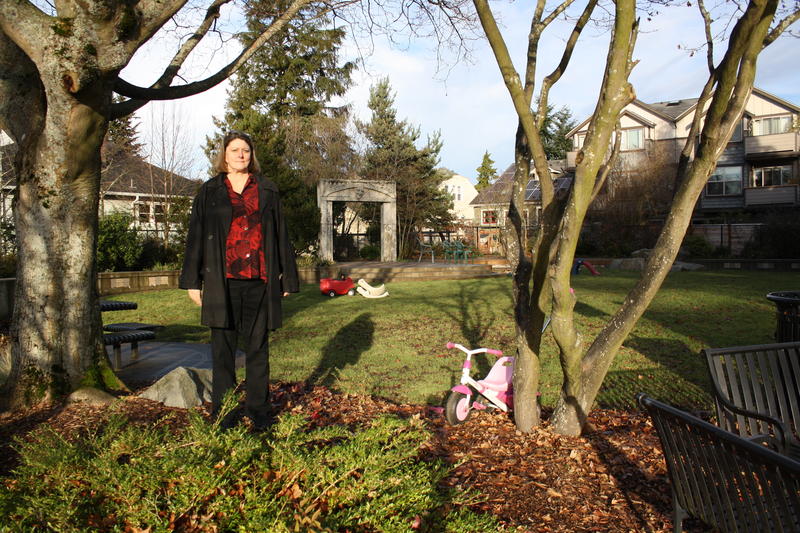
Cass Turnbull, an open space advocate, says the 6th Avenue pocket park in Greenwood shows how a former substation can make a great park.
Seattle City Light is selling off a bunch of obsolete substations. Some open space activists want to nab that land for parks or other open space, but it turns out it’s not so easy to transfer land from one department to another.
You may have seen electrical substations around Seattle. There’s usually a fence with a bunch of weird-looking electrical equipment inside. There’s usually a concrete slab, or gravel. Often they’re surrounded by mature landscaping that helps them blend into the neighborhood. But changing technology has rendered them obsolete.
Open space advocate Cass Turnbull can’t drive by them without thinking of their potential as parks.
“Yeah, I’ve seen them when I’m driving, like, 40 miles an hour. And I’ll go, ‘ERRRRR!'” Turnbull said, imitating the sound of her car braking. “I recognize that fence, there’s a substation in there!”
The substations are being sold off in batches. Falling energy prices have cut away at revenue Seattle City Light used to make selling excess hydropower on the wholesale market.
Most of northeast Seattle’s substations have been sold. Southwest Seattle’s substations are being cleaned and cleared and should hit the market next year. Substations in northwest Seattle will follow in the years after that.
Community groups that want to see the former substations become parks, tree banks or community gardens must compete against developers for the properties.
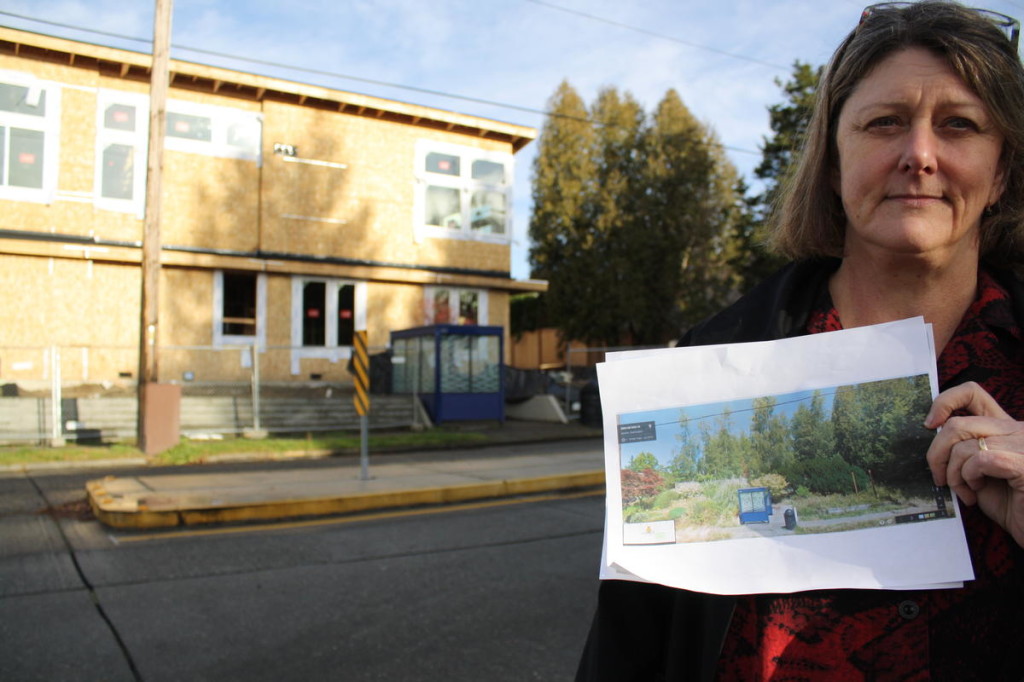
Cass Turnbull stands before a former substation site. She holds a Google Street View image showing the landscaping recently removed to make way for townhomes.
Turnbull showed me a substation in northeast Seattle that’s being turned into townhomes.
“Well this was another heartbreak because it did have such a nice landscape,” she said, looking at a printout from Google maps that shows the mature landscaping; landscaping now scraped away. “Seattle City Light had a real heritage of great horticulture. Beautiful landscapes, well tended over the years, and I think that’s all going by the wayside now.”
Seattle Parks and Recreation prefers parks to be 10,000 feet or more.
“Smaller parks don’t work very well,” explained spokesperson Joelle Hammerstad. “There are plenty of examples in Seattle and around the country of the challenges and failures of small pocket parks. Larger parks tend to have more utility, more eyes on the park and are generally more successful.”
Turnbull is tired of hearing that reason.
“There’s always a good reason not to save a substation,” she said. “But my position is that we need as much green space as we can get our hands on, because we’re going to have a whole lot more density.”
Turnbull said a determined neighborhood can hold on to these sites. She took me to the 6th Avenue Pocket Park in Greenwood and pointed to the mature trees around the perimeter. “[These] were kept from the original substation. These aren’t little dinky trees that we have to wait 30 years to find.”
The park was paid for using money from the Pro Parks Levy and King County. But Turnbull said the current system requiring full payment for land the city already owns is too onerous.
Turnbull and the West Seattle Greenspaces Coalition asked for all nine of the substations in southwest Seattle, which includes one in Seatac and another in Burien, to become open space. But the group didn’t have the money to buy them and it didn’t have support from the Parks Department.
The green space group’s plan also didn’t fly with Seattle City Light.
“We have a goal in mind, which is to be able to sell these properties to meet our budgetary needs,” said Lynn Best who heads the utility’s real estate department.
Best said utilities don’t have a lot of discretion, either. “Under state law, if you have utility property, it either has to be used for utility purpose, or we have to get full market value for selling it or renting it.”
Still, Best said Seattle City Light does what it can to accommodate community groups. “Sometimes a property comes along that is particularly valuable to a particular community,” she said. “If people have a serious plan for how they want to go about doing this, we will certainly listen and try to help.”
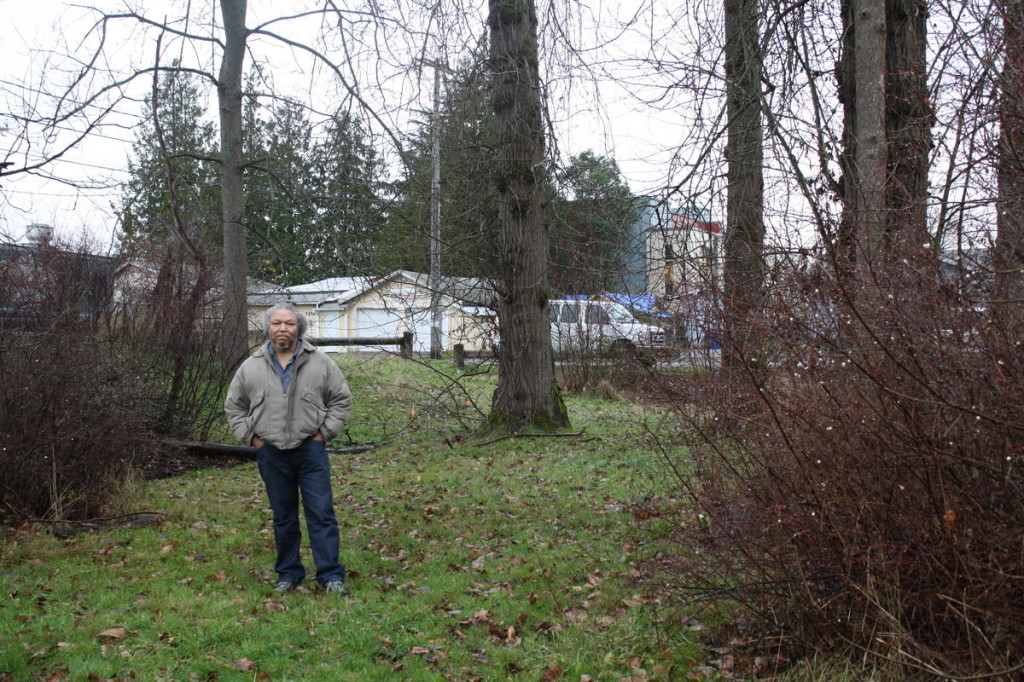
Willard Brown of the Delridge Neighborhoods Development Association wants this former substation to become a community garden. Behind the photographer, a fenced-in area with polluted ground will have to be cleaned up, Brown said.
Willard Brown of the Delridge Neighborhoods Development Association wants this former substation to become a community garden. A fenced-in area on one corner of the site is polluted, and will have to be cleaned up, Brown said.
For example, one proposal caught Best’s attention. It came from Willard Brown, a member of the Delridge Neighborhoods Development Association in southwest Seattle.
Brown said the Delridge neighborhood looks green, as you’re driving through it, but all that green is in inaccessible Green Belts, up on the hillsides.
“You cannot get in there,” he said, “unless you’re willing to be Paul Bunyan and clear a path!”
Brown continued, “Even though we have greenbelts running throughout Delridge, accessible green space for entertainment and pleasure is minimal.”
Brown wants the Delridge substation to become a community garden. “Kids like working in gardens,” Brown, a grandfather, said knowingly.
He considers himself lucky to have a backyard where his grandkids can plant, harvest and compost. “They don’t like mowing lawns,” he said, “but they do like digging in the dirt.”
Brown gestures towards the K-5 STEM at Boren Elementary School just down the road. He said a community garden will give the kids something to do after school besides play video games.
“When we were young, you didn’t have sit-down games and sit around the house and look at TV. In fact, if you’re in front of the TV, you got kicked out of the house!”
Brown said there aren’t many places in Delridge where you can send kids anymore. But for Brown, there’s much more at stake for the kids in this neighborhood than just getting enough exercise. He said when people grow food together in a public place, they become a community.
“We learn culture that way. We learn about each other that way,” he said. And in a diverse neighborhood like Delridge, Brown said creating destinations where the community can meet each other is critical.

Willard Brown
Brown said he wants the kids in his neighborhood to take pride in Delridge, saying he’ll consider the project a success when the kids pass by the neighborhood when they get older and he hears them say, “Hey, there’s my garden. That’s our garden. It’s still here.”
But even with Seattle City Light’s support, paying full market value has proved a burden to Brown’s group. They’re working on grant proposals to come up with the $80,000 to $90,000, but nothing’s come through yet.
And as Seattle City Light prepares to offload southwest Seattle’s unneeded substations, the clock is ticking.
Any sale of the utility’s land must be approved by the Seattle City Council. That process should happen for southwest Seattle’s substations early next year.
Guerilla planters’ protest Seattle City Light selling unused properties
Seattle TIMES 8-14-14
By David Ham
SEATTLE —
Cass Turnbull said she’s among hundreds of Seattle citizens petitioning Seattle city leaders to save unused Seattle City Light surplus land as green spaces.
“It doesn’t make sense and it seems wrong that people are making profits off of land that the city owns, and the city is going begging for green spaces,” said Turnbull, who is also involved with Tree PAC.
Seattle City Light is in the process of selling 22 of its unused former substations and other surplus land.
Three properties have been approved by the city council to sell; nine other properties are under review for sale by the city council, and 10 other properties may also be reviewed by the city council for sale at a later date.
A spokesperson for City Light said that since the properties were purchased with rate-payer money, state law says they have to be sold at fair market price.
“They have every right to sell it and they’ve gone through the necessary notifications,” said Arvin Vander Veen, who is the agent for one of the properties for sale at 80th and Aurora.
He expects City Light to get at least seven offers for that property that will sell at a minimum of $600,000.
“The market we’re in right now – multi-family – is creating a lot of demand. I mean, Seattle’s creating a lot of jobs,” said Vander Veen.
In protest, Turnbull said that concerned citizens are planting trees and shrubs on some of the properties City Light has listed for sale.
“I think somebody called them guerilla plantings or drive-by plantings. I don’t know who’s doing it but somebody cares enough to bring the plants over,” said Turnbull.
Councilmember Tom Rasmussen understands the importance of preserving green spaces in the city.
He said he is working with citizen groups to see if there’s a way that the city can keep the properties for public use.
The council will be considering a Statement of Legislative Intent on Friday.
According to meeting records, the item would: “identify potential inconsistencies or opportunities for improvement in the City’s current policies concerning the acquisition and preservation of open space and natural areas, especially as they relate to existing City goals such as those found in the Urban Forest Stewardship Plan and the Climate Action Plan; and ii. make recommendations concerning the management and operation of an Open Space Opportunity Fund, including recommendations on how the OSOF could help advance City and community goals and priorities.”
“It also doesn’t make sense to ask the public to raise money to buy land that the city already owns. It’s just not right,” said Turnbull.
TreePAC Position Statement
Voluntary tree preservation on private property will not work to save the essential canopy cover in Seattle and King County. This is confirmed by the fact that Seattle has lost 50% of its canopy cover over the last 50 years. We must have both regulations and compelling incentives.
Permits for tree removal, a mitigation fund for unavoidable tree loss during construction, and utility fee credits for tree canopy cover are just three ways to accomplish this. Current and upcoming ordinance proposals are woefully insufficient to the task.
The trees of Seattle and King County can no longer be considered just ornaments-in reality, trees are privately owned public utilities that clean the air, prevent urban flooding, cool the globe, and sequester carbon. Like the air and water that exist on private property, trees need to be managed for the public benefit. If local government can tell people what they can and can’t do with their banana peels, we ought to be able to compel residents to retain at least some trees-and reward them for doing so-for the present and future public benefit.
A Fight for Urban Trees, Seattle Times 8/14/2014
“People come here for the jobs and the great climate and because it’s green,” said Cass Turnbull, founder of the nonprofit Plant Amnesty, and TreePAC, a political nonprofit formed to advocate for urban trees.
“Pretty soon it will just be for the jobs,” she said. “That would be sad.”
Green space proponents say ‘build parks’ on vacant substation lots rather than develop
TreePAC in the News:
Ballard News Tribune
Green space proponents say ‘build parks’ on vacant substation lots rather than develop
By Shane Harms
11/11/2014
North Seattle residents could start seeing more old utility substations developed, which is spurring some citizens to ask the City to think green.
The vacant lots are a way for the City to recoup financial losses due to budget cuts, and there is a history of the sites being sold to the highest bidder.
The properties are vacant land that used to be substations in the 50’s and 60’s and owned by Seattle City Light (SCL). As technology changed, fewer substations were needed. They are recognizable by small concrete surfaces where electrical equipment used to be. In 1968 there were 150 of these properties.
26 years ago, Cass Turnbull, founded Plant Amnesty, a green space advocacy group. Turnbull is a life long gardener and says that the City needs to prioritize green spaces, and that substations are an obvious choice.
“In my heart I get a lot of comfort from trees and green spaces, but I also know they serve a good utilitarian purpose. There is a suite of benefits from green spaces that the City desperately needs more than ever. They are a place to go for the public. They provide tree canopy and prevent runoff…selling them would be irresponsible.”
The sites are about the size of one or two house lots (5,000 square feet) and scattered throughout the city. There were nine in the Ballard area, but now two remain vacant (Sunset Hill: 3209 NW 65th St. and in Ballard: 6730 24th Ave. NW). Some were turned into parks and the rest were sold.
There are eight remaining vacant substations in the broader north Seattle area that are owned by the City and some of those properties are up for sale.
“The sites should be retained as green spaces. Instead they will most likely be sold for development – sold to the highest bidder… It rubs me the wrong way. These are perfectly good spaces that are going to developers, but they could be kept for public use,” said Turnbull.
One site that is in the process of being sold is the Green Lake substation at 949 N. 80th. The City approved the sale of the site last year. Bids are due November 14th.
Turnbull believes the site should be a vegetated buffer between the commercial area on Aurora and the neighboring residential building.
“The agent is collecting bids for the Green Lake Surplus Substation property now, but we are trying to stop this sale from happening and in the future.”
PlantAmnesty is working with the Green Space Coalition to turn other vacant sites across the city into green spaces for public use before the City sells them.
Turnbull has been monitoring the use of vacant substations for a long time and says she can “spot one going 40 miles.” She is watching 10 to 15 more potential City owned sites that will likely become surplus in the near future. Developers are likely doing the same. According to her notes, in 2002 SCL owned 53 surplus properties and so far, seven turned into parks, six went to public housing and three were put on hold for future use by SCL. Eight sites were sold to the highest bidder.
What about the neighbors?
Penny Barker has been living next to the substation in Sunset Hill for over 18 years. The vacant substation is directly behind Ristorante Picolinos, but unsuspecting citizens probably wouldn’t know it’s there unless they are looking for it. The substation is hidden from the street, accessible by alley only and vegetation riots around it.
“It’s really just fine the way it is. It’s becoming quite the green space with all the trees growing over it. Who needs to do anything with it? It could be a P-patch, or something quiet and green,” said Barker.
Barker is not optimistic about the fate of the substation.
“I do think the City will sell it to developers, and I know that the neighbors would be up in arms about it and feel strongly against it.”
Barker reported that in the past the City appraised the lot at $425, 000.
“It’s hard to imagine anyone would want to build something there unless it were really tall.”
Currently, there are no plans for the substation. At one point Ground Swell NW submitted a proposal for a solar panel station and park. SCL deemed the proposal “complex,” and tabled it.
Sunset Hill substation. Shane Harms
So how are substations sold?
During the official disposition process, before the properties are put on the market, the City offers to sell the land to other departments. They also look for potential buyers like the businesses next door. If the properties don’t sell, the City notifies the neighborhood. Sometimes with enough momentum, neighbors can lobby the Seattle City Parks Department to purchase a few of the properties if funding allows. If no takers, the properties are sold to the highest bidder. A similar scenario played out in Northeast Seattle in 2013 and is currently in the works in Southwest Seattle.
In 2006, Matt Rosenberg — founder and editor of Public Data Ferret — reported that SCL had 212 excess properties worth $35 million.
“ I get it. It makes sense that the City would want to sell lots to make up for cuts, but people are freaking out about development. I’m all for density, but responsible density; you need a giant park to go with giant buildings. I don’t know where these people are going to go.”
So why cant the City just hand over the sites to the Parks Department?
Washington State has laws that prevent one public agency from handing over property to another, which is an indirect result of laws set to prevent the public offices from getting into murky land deals with the private sector.
Turnbull, however, thinks there are ways to make the law work for green spaces.
“It looks like it’s impossible to save the lands based on the laws we have, but there are ways to work around it.”
In Turnbull’s eyes, one way to look at the substations is that they are energy-conservation sites; substations could be made into City managed tree banks. Turnbull says that trees conserve energy, especially in the summer, providing a cool place for people to go rather than turning on air conditioners, saving the City and citizens money. She also said green sites act as the lungs of the city and cut back on carbon emissions and also filters runoff. Seattle Public Utilities is already building rain gardens all over Ballard to prevent runoff from overwhelming the sewer system.
“The tree banks could turn the vacant lots into a park or an orchid or a garden — anything really.”
Furthermore, Turnbull thinks that if a developer wants to develop a potential site that has the capacity for saving the City and citizen’s money and protecting the environment, they should have to pay impact fees to develop.
As for the substations in Ballard, they are not for sale yet. However, there is talk that the Northwest substations are up for disposition as soon as the Southwest dispositions are finished in later 2015.
“We have enough development and not enough green space. We are well on our way to meet development goals than we are for green space. It’s easier to retain land rather than turn it into a green space after its been developed.”